
I am interested in building AI systems that can plan, adapt, and generalise in complex environments. My research focuses on AI planning, reinforcement learning, abstraction, and decision-making under distribution shift.
I hold an MSc in Machine Learning (2023), supervised by Prof. Piotr Miłoś and Prof. Marek Cygan, and a BSc in Computer Science (2021), supervised by Prof. Henryk Michalewski and Prof. Łukasz Kaiser, both from the University of Warsaw, MIM Faculty. I currently work as a Senior AI Consultant at EY on agentic AI systems for the European Commission, involving EU legislation across Member States and candidate countries.
My current research direction is adaptive planning in learned latent spaces: systems that adjust their planning horizon and level of abstraction to problem difficulty, progress, and changes in the environment.
Alongside this, I have gained experience in research and engineering roles at NVIDIA, Microsoft, Samsung, DeepFlare, and EY. Since 2020, I have also been involved in the ML in PL Association, supporting scientific programme activities and conference organisation across several editions.
Research
Publications
Fast and Precise: Adjusting Planning Horizon with Adaptive Subgoal Search
ICLR 2023 · Oral
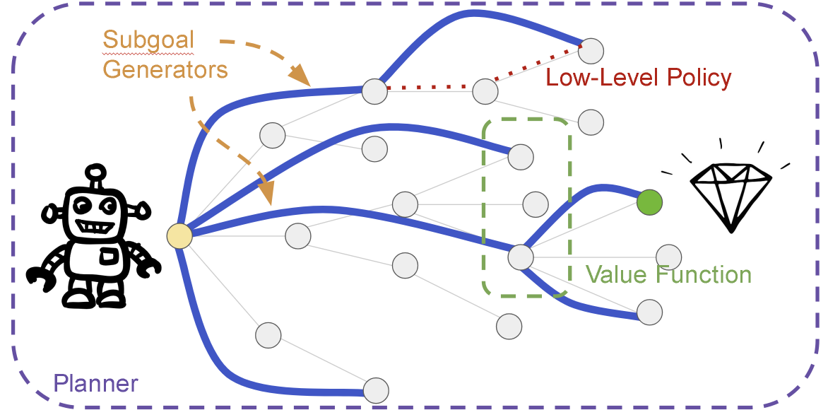
Adaptive Subgoal Search adjusts its planning horizon to local problem difficulty by combining subgoals at several temporal distances with reachability verification.
What Matters in Hierarchical Search for Combinatorial Reasoning Problems?
ICLR 2024 · Generative Models for Decision Making Workshop
A controlled study of when hierarchical search helps: difficult value functions, complex action spaces, dead ends, heterogeneous demonstrations, and distribution shift.

Hierarchical Transformers Are More Efficient Language Models
Findings of NAACL 2022
Hourglass introduces explicit downsampling and upsampling into a Transformer, studying hierarchical abstraction as a route to more efficient long-sequence modelling.

Enhancing Antigenic Peptide Discovery: Improved MHC-I Binding Prediction and Methodology
Methods, 2024 · ICLR 2023 · MLDD Workshop
An analysis of evaluation and generalisation pitfalls in MHC-I presentation prediction, together with a new benchmark and the HLABERT model.

Preprints
Resolution of Recursive Data Corruption to Transform T-cell Epitope Discovery
bioRxiv preprint, 2026 · revised manuscript under review
Predictor-dependent curation can preserve strong standard metrics while eroding genuine candidate-discovery performance; deepMHCflare reframes the problem as protein-centric learning-to-rank.

OpenGVL: Benchmarking Visual Temporal Progress for Data Curation
arXiv preprint · 2025
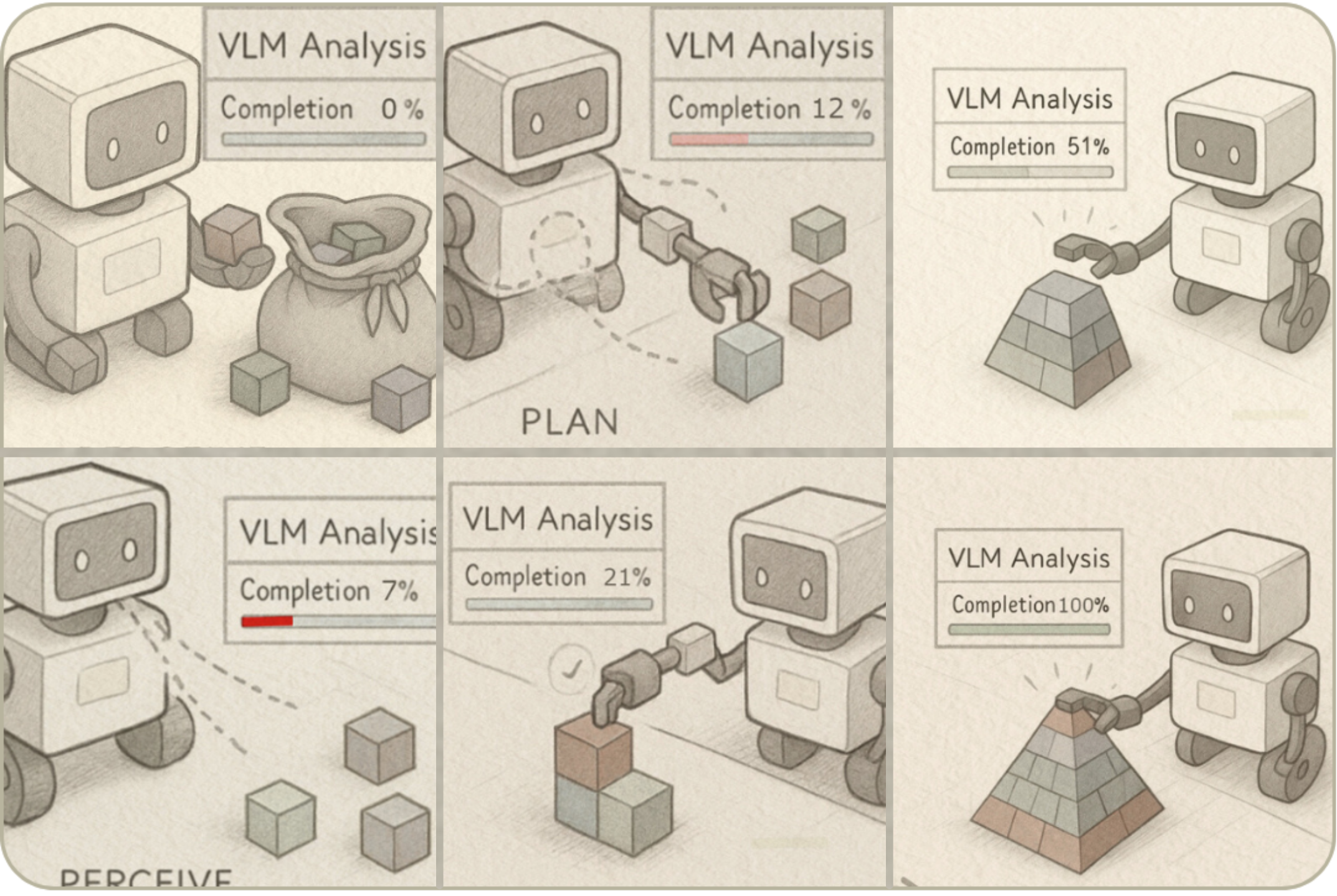
A benchmark and toolkit for evaluating temporal-progress estimates from vision-language models and using them to curate robotics video data.
Selected software
- DeepFlare.ai - contributed to an AI platform for in-silico immunogenicity prediction.
- CaRL - open-source framework for reproducible learning experiments in combinatorial planning.
More projects and open-source contributions are available on GitHub.
Recognition and community
- ICLR 2023: Oral (top 5%) for Fast and Precise: Adjusting Planning Horizon with Adaptive Subgoal Search.
- EEML 2025: Best Poster Award in Reinforcement Learning for Hierarchical Search Landscapes, continuing the study of hierarchical planning and generalisation.
- Long-term involvement with the ML in PL Association, including scientific programme work, conference organisation, and co-leadership.
Contact
For any enquiries, .